
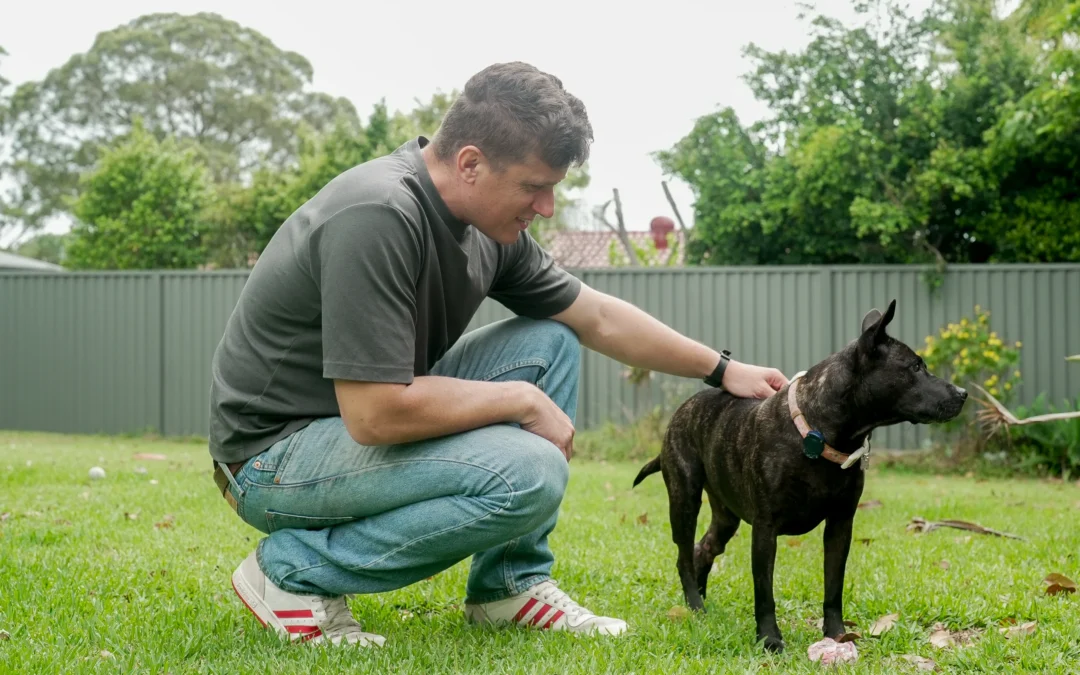
The story of Rosie, an eight-year-old Staffy cross Shar Pei from Sydney whose owner used AI and genomic sequencing to design a personalised mRNA cancer vaccine, captured global attention in early 2026. It is a genuinely remarkable case. It is also widely misread, and that misreading matters for how Australians think about genomic medicine.
Rosie’s owner, Paul Conyngham, is an AI consultant and entrepreneur with no background in biology. When his dog was diagnosed with aggressive mast cell cancer and given months to live, Conyngham used ChatGPT and Google DeepMind’s AlphaFold to identify neoantigen targets in Rosie’s tumour DNA. He also partnered with scientists at UNSW, including Associate Professor Martin Smith at the Ramaciotti Centre for Genomics and Professor Pall Thordarson at the UNSW RNA Institute, to produce the physical mRNA vaccine. The treatment was administered by Professor Rachel Allavena at the University of Queensland.
The result was a partial response: Rosie’s largest tumours shrank, her mobility returned, and her quality of life improved. Some tumours did not respond. Her cancer, in aggregate, remains incurable.
That complexity is exactly where the interesting questions live.
1. AI Did Not Cure Rosie's Cancer, But That Is Not the Point
The most important thing to understand about Rosie’s case is what it does not show.
It is a single animal, not a controlled study. Rosie was treated with both a personalised mRNA vaccine and an immune checkpoint inhibitor, so the relative contribution of each treatment cannot be separated. Mast cell tumours can behave unpredictably. As Professor Thordarson noted publicly, some of Rosie’s tumours did not respond and are being resequenced to understand why.
What the case does show is something more foundational: the pipeline from tumour biopsy to personalised mRNA vaccine can now be completed in months rather than years, and the design step (identifying which mutations to target) can be navigated by a non-biologist using AI tools, with scientific oversight.
That is a genuine shift. Not a cure, but a shift.
2. The Genomics Infrastructure Already Exists in Australia
Conyngham did not build this from scratch. He accessed services and partnered with world-class expertise in the field that already existed.
The genome sequencing was performed by the Ramaciotti Centre for Genomics at UNSW, a facility operated by Bioplatforms Australia, an InGeNA member organisation. The mRNA production was handled by the UNSW RNA Institute. The ethics pathway, though gruelling (Conyngham spent three months on the application) ran through existing institutional frameworks.
“Within a three-month time frame, we’ve gone from almost no hope to actionable results in a living organism,” Associate Professor Martin Smith told UNSW News. “That’s absolutely fantastic.”
The sequencing of Rosie’s tumour produced around 150 billion letters of DNA. Processing that data, identifying neoantigens, predicting protein structures. This is exactly the kind of work that commercial genomics companies in Australia’s industry ecosystem are building tools to accelerate.
3. The Regulatory and Reimbursement Questions Are the Real Story
Professor Thordarson used a striking analogy in his public commentary on the case. He compared the coming shift in personalised medicine to what happened in Australian energy over the past two decades: a market that moved from a handful of centralised mega-generators to millions of households with rooftop solar and batteries, buying and selling electricity wholesale.
That transition was not smooth. Blackouts happened. Regulators scrambled. But the industry adapted.
Personalised medicines designed by the end-user, in Thordarson’s words, will happen. The question is whether Australia’s regulatory and reimbursement architecture is ready.
In human medicine, a personalised mRNA cancer vaccine faces a clear but lengthy pathway: clinical trial evidence, a Health Technology Assessment submission, and review by the Medical Services Advisory Committee (MSAC) before any MBS listing. That rigour exists for good reason. It is also exactly where InGeNA’s advocacy work operates, making the case to government for reimbursement pathways that keep pace with what the technology can now deliver.
The cost issue is not trivial. Professor Thordarson noted that Rosie’s treatment costs were difficult to estimate given the in-kind contributions of research teams, and that the co-administration of a checkpoint inhibitor (itself a Nobel Prize-winning therapy) made overall costs significant. Equitable access to personalised genomic medicine will require both regulatory reform and new reimbursement models.
4. mRNA Technology Is Moving Faster Than Most People Realise
Rosie’s story is unusual. The science behind it is not.
Personalised mRNA cancer vaccines are in active clinical development for human patients right now. A Phase III clinical trial, INTerpath-002, is exploring personalised neoantigen vaccines in combination with pembrolizumab for resected non-small-cell lung cancer. A landmark study published in Nature in 2025 demonstrated that mRNA vaccines can sensitise tumours to immune checkpoint inhibitor therapy.
Earlier work showed long-term remission in a subset of patients treated with personalised mRNA vaccines for pancreatic cancer – one of the most treatment-resistant cancers known.
“Over the past 10 years, science has really caught up with cancer,” Professor David Thomas, medical oncologist and Director of the Centre for Molecular Oncology at UNSW, told UNSW News. “Today, taking part in clinical trials offers six times the benefit that it did back in the 1990s.” David is also the founder and Chief Science and Strategy Officer of Omico, a partner of InGeNA, which has spearheaded nationwide initiatives to translate cutting-edge genomic technologies into tangible therapeutic advancements for Australians with challenging cancers, improving outcomes for many patients.
There are currently more than 2000 oncology drugs and therapies in clinical development worldwide. The bottleneck is not the science. It is the speed of product design and manufacture, the cost of the sequencing and bioinformatics pipeline, and the regulatory pathways needed to bring personalised treatments to scale.
Each of those bottlenecks represents a commercial opportunity for Australian genomics companies, and a policy challenge that requires a coordinated industry voice.
5. Australia Has a Unique Opportunity Here
Professor Thordarson made a pointed observation: equitable access to personalised medicine may actually be more achievable in countries like Australia, where the government funds healthcare at a population level. The infrastructure for government-outsourced personalised medicine which requires sequencing, bioinformatics, and/or mRNA production could, in principle, be offered universally rather than only to those who can self-fund.
“There’s no doubt in my mind that Rosie’s journey is going to be seen as a milestone in terms of making this technology fully sovereign for Australians,” Thordarson told UNSW News.
Achieving that requires three things working in parallel: commercial genomics companies investing in scalable sequencing and mRNA production capabilities; a regulatory environment that can process personalised medicine applications without the decade-long timelines designed for mass-manufactured drugs; and reimbursement pathways through the MBS that reflect the actual cost benefit of these treatments.
InGeNA exists to advance exactly those conditions. As the industry voice in government policy discussions, the convenor of the companies building this pipeline, and advocating for the infrastructure and systems that will enable all Australians to access life changing precision medicines faster.
Rosie’s story is not the arrival of personalised genomic medicine in Australia. The infrastructure and expertise was already here. The story is a vivid public demonstration of what that infrastructure and workforce can now do – and a clear signal of how much further it needs to go.
Read more on InGeNA’s submissions to policy by clicking here.